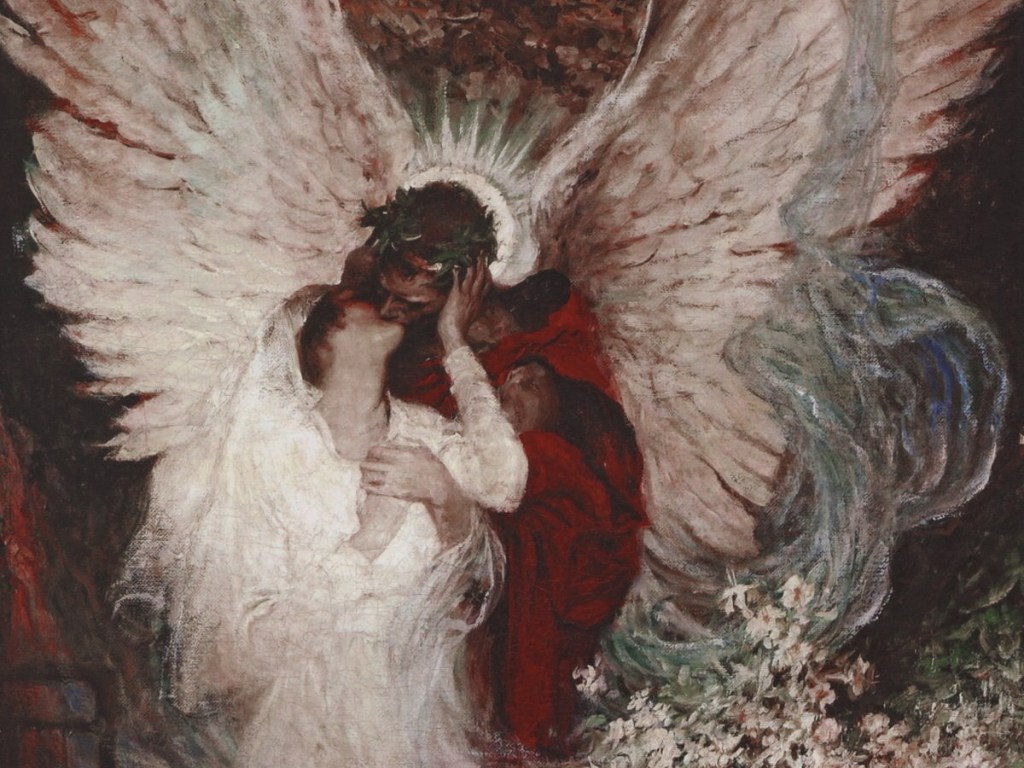
Love is the greatest sin. It is that which, as it trembles within your cold and lonely self, brings the sun into being in the blink of an eye. It is what brings the ever-distant god—darkened by your eyes—right before you. It is a moment, a fleeting glimpse, a transient feeling. It is a ritual you swear you won’t perform every night, yet every morning you do it again. It is a verse on the page of holy books, the reason for your heartbeat, the irrationality of your mind. Love is everything you have rejected.
Even if he wanted to, he woke up without thinking of anything else. Seeing her portrait on the ceiling, he smiled. He closed his eyes—not to see, but to feel; to repeatedly conjure his dream in his mind. He thought, “There is a moment”—the moment when logic takes command of the mind and forces its focus back onto life to fulfill its obligations, the very moment when one struggles to stay in bed. He had known since the first moment of the day that the reality of life would kill his imagined happiness. And that knowing would offer no solution either…
Love is like a belief. It is an experience in which you disregard the truths you think you know, become ensnared by an idea, and leave behind a person you no longer recognize when you look back. It is an experience where you lose your capacity for rational thought and find meaning amidst all absurdities, binding the entire purpose of your life to that person.
In the home where he realized he knew nothing, he unconsciously completed his necessary routines and took his first step into streets of which he was unaware. He was walking yet not seeing, thinking yet knowing nothing; his mind was like that of a prisoner straining to catch sight of the moon through the bars of a cell window. By the time he noticed the smile on his face, he had long since left home.
Is loving and being in love the same thing? We feel someone like being struck by a violent lightning bolt, and soon that intensity diminishes, giving way to a less forceful but enduring state of emotion—the continuity of which defines our idea of love. We eventually come to realize that everything we remember about our relationships, after a certain time, consists only of the meanings we imposed on the other during its most intense phase.
As he passed by, he trusted people who, like little ants, moved along; he found them close to him, and he respected the bitter stories hidden within their monotonous exteriors. For the first time, he felt close to society—rejecting the notion that they had marginalized him—and he no longer imagined a scenario where he was excluded. The place of his thoughts, once estranged from life, had changed. How was it that the society from which he had long separated himself had now embraced him?
Our effort to find our place within society might be limited to one person; when we harbor intense feelings for that right individual, we shatter those chains and have long since carved a niche for ourselves within them. Breaking our chains is intertwined with love; if we feel that overwhelming emotion toward someone, our romance extends to all of humanity.
He took a deep breath as if he had never done so before, letting the excitement—fueled by his accelerating heartbeat—allow him to feel once more the melody of his heart. The lyrics of a song converged into a single name, constraining the freedom of his thoughts. He thought, “A life worth living for her, things in life so precious that they are experienced only a few times…” Is love an entity that creates things worth living for, or merely a phenomenon? All he knew was that, deep within his soul, there were things that poisoned him—things worth living for. The image that haunted his mind, the longing without limits, the admiration he felt for every word that left her lips, the love he held for her presence—all of it merged into the singular dynamic of his thoughts.
Was love the unattainable desire? When we reach the person we long for, will we ever feel emotions as intense as before? Perhaps it was a reflection of the profound emotional burden that the sorrow of unattainability imposes on the human mind. Maybe our goals themselves are mere pursuits of that desire, which is why, even upon reaching them, we never achieve satisfaction—we always feel something is missing, the determination we lost along the way. Determination, love, hope, path, goal… all are, in essence, the deep sorrow of unattainability.
She always appeared before his eyes as a silhouette so near, yet in truth she was so far away as to be unattainable. Perhaps he was being deceived by love; could it be that the intense emotional state wrought by humanity was misleading him? He had been deceived, by a passion so intense… Perhaps humanity’s fundamental flaw lies in its inability to recognize when it is being deceived. With senses shutting down in dark alleys and thoughts awakening within them, he moved forward. What had he done today? He had thought of her… so fragile that he remained oblivious to the rule of life.
What is it that makes love, love? Is it the burst of emotional intensity that quickens our heartbeat and perhaps creates an identity for the person we love—a persona that may never truly belong to them, shaped by the meanings we assign? A burst that seems endless at first, but eventually gives way to habit.
The first thing he noticed upon entering his home was that he still had not awakened. He had been lulled to sleep by love and roused by love. He was treading the liminal line, worshiping hell, and hating heaven… Love is that which transforms our hell into heaven and diminishes the irresistible pull toward the distant gates of paradise; perhaps love is the most beautiful dream of all.

 soli
soli 