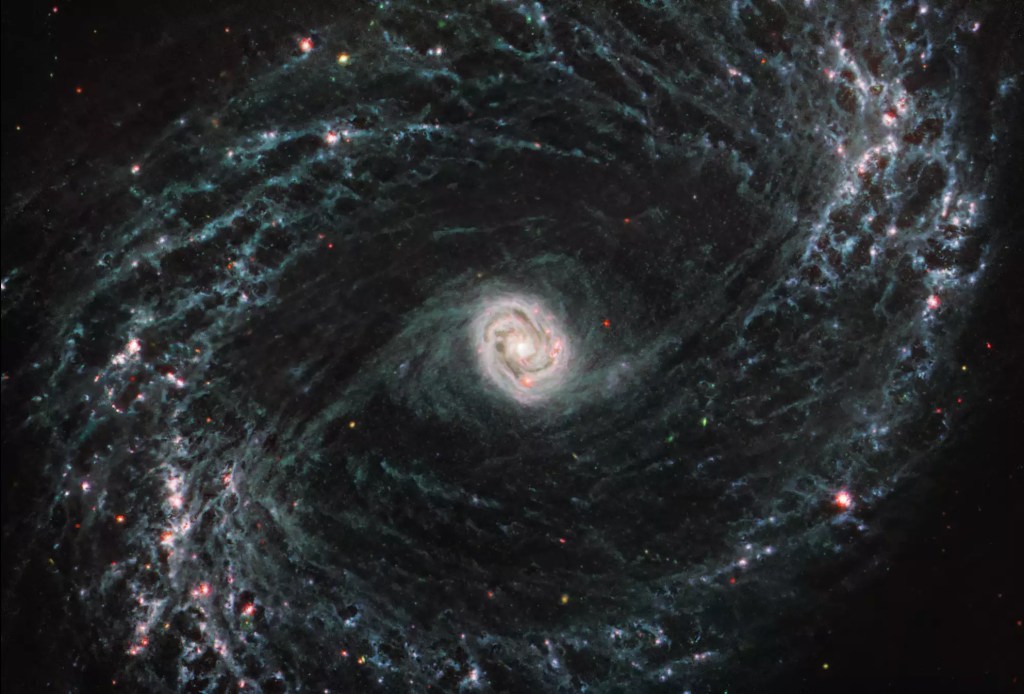
In the beginning, there was nothing—perhaps there was a great chaos. As a result of this duality, everything that exists eventually converged at a single point. The darkness of the universe gave way to light.
We describe the first lights of the universe as the initial moments of the Cosmos, known as the Big Bang, which occurred 13.7 billion years ago. In an incredibly brief span—about 10-44 seconds, known as Planck Time—everything we know as the laws of physics emerged from “one.” That infinitesimally small moment, beyond the grasp of our minds, conjured up the idea of the Theory of Everything, a concept famously associated with Stephen Hawking. This theory embodies our attempt to understand the mystery behind that very moment. But if all physical laws emerged from “one,” what is this “one”? Can a theory be constructed that unifies them all?
Shortly after the end of Planck Time, a process we call the Inflationary Epoch took place—a rapid expansion in which the universe’s initial boundaries were formed within about 10-32 seconds. Again, the point of rupture where “one” multiplies into many is marked by the separation of the four fundamental forces; this separation occurred between 10-32 and 10-12 seconds. With this separation, the foundations of what would later be called matter were laid. Could a minuscule alteration in the initial conditions have led to results so profound as to completely change everything we now know as the universe?
While the universe’s temperature was around a trillion degrees, fundamental particles such as quarks and gluons emerged. Quarks gathered together to form larger particles like protons and neutrons, which in turn constituted the matter we observe or know. Yet, there was a problem; rather than forming equal amounts of matter and antimatter, more matter than expected came into existence—and over time, this matter eventually formed stars, galaxies, and ultimately us.
In the minutes following that chaotic first second, as the universe continued to expand and cool, protons and neutrons fused to form the nuclei of hydrogen and helium. As the universe expanded further, its temperature dropped even more, and atoms began to form. Electrons attached themselves to atomic nuclei, ushering in an era in which light could travel freely. Just as the greatest chaos of the universe came to an end, time gave rise to a new kind of chaos.
For 380,000 years—what is called the Dark Ages—the universe continued to cool, and about 100–200 million years later, the first lights began to shine. Massive gas clouds composed of hydrogen and helium, drawn together by gravity, initiated the formation of stars. These first stars were enormous—roughly 100 times the size of the Sun—but they had a flaw: due to their enormous size, they did not possess enough fuel to sustain long lifespans. Through fusion reactions, hydrogen in these stars was converted to helium, causing their fuel to run out rapidly—the greater a star’s mass, the quicker its fuel was expended—and giving rise to the spectacular supernovae (the enormous explosions marking the death of massive stars). These explosions were so magnificent that they shattered everything in their vicinity. With temperatures and pressures so extreme, they enabled the formation and dissemination of heavier elements throughout the universe. The high-energy light emitted by these first stars allowed light to travel more steadily through space. In the subsequent process following the first billion years, stars coalesced under the force of gravity to form the first galaxies.
The formation of our Earth began 4.6 billion years later, amidst this chaos, with the birth of a star named the Sun in the Orion Arm of the Milky Way galaxy—a process that unfolded among billions of galaxies. The Sun’s formation occurred when the remnants of previous supernova explosions, along with hydrogen and helium, collapsed under gravity into a single point—a singularity. A disk of dust and residual heavier elements orbiting around the Sun gradually coalesced into the first rocky bodies. These massive rocks collided with each other, forming the first proto-planets, which in turn collided to create the early planets. One of these primitive planets, accumulating mass under the influence of gravity, eventually became the early version of the Earth we inhabit today. During this period, a Mars-sized proto-planet named Theia collided with Earth, causing a massive ejection of material from our planet’s outer layer into space. These materials gathered in Earth’s orbit and eventually formed our Moon. This collision also affected Earth’s tilt and its rate of axial rotation, contributing to the development of the seasons and the length of our day. In truth, we owe our existence to Theia; it is through the passionate dance of its chaotic orbit with our planet that the romanticism of humanity was born.
Early Earth was extremely hot—so much so that it was initially molten. This high temperature kept much of the planet in a liquid state. Over time, heavier elements sank toward the center, forming the core, while lighter elements ascended to create the outer layers—the mantle and the crust. As the Earth’s crust cooled, cratons—the cores of the first continents—began to form. Because the Earth’s crust is in constant flux due to plate tectonics, these cratons collided and separated, forming new continents. This process led to the emergence of mountains, valleys, and various geographical features on Earth’s surface. Water filled the rifts between the continents, giving rise to the formation of oceans, which in turn laid the foundations for the emergence of life.
There is nothing distinctive in our planet’s formation process that sets it apart from the planets of other stellar systems. Our orbit is in constant motion, and our position relative to the Sun is ever-changing. With 100 billion galaxies, 200 billion star systems in just our own galaxy, and assuming an average of three planets per star system, it is impossible not to wonder if similar processes might have occurred elsewhere. We are not as special as the books might have us believe; no matter how deeply we search for order, we always encounter great chaos. Chaos is an indispensable part of existence, and we are but primitive beings striving to keep pace with it.
 soli
soli 
Leave a comment